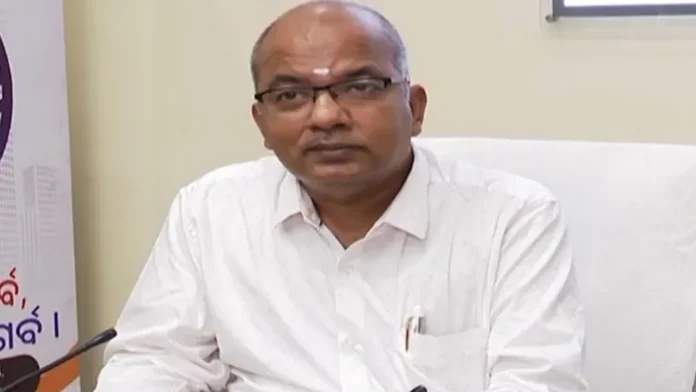
In a significant development, senior Odisha cadre IAS officer R. Santh Gopalan (IAS:2001:OD) applied for voluntary retirement on Wednesday. The development has surprised the state bureaucracy, as it has come within a month after the Bhubaneswar DCP, Jagmohan Meena (IPS:2013:OD), resigned from the service.
He has more than one-and-a-half years of his service left, as he is scheduled to retire in June 2028.
According to reports, Gopalan, currently serving as the Chief Electoral Officer and Secretary of the Excise Department, has cited personal reasons for the VRS.
The development is significant as Gopalan continues to hold key responsibilities in the state administration. Further details regarding his voluntary retirement application are awaited.
Earlier, Bhubaneswar Deputy Commissioner of Police (DCP) Jagmohan Meena’s resignation was accepted by the Central Government.
Sources say the state govt had accepted Meena’s resignation on August 27 and forwarded it to the Union Home Ministry for further action. The Centre has now accepted his resignation with effect from September 11, 2026.
In a major disciplinary action, the Gujarat govt compulsorily retired two IAS officers — Kankipati Rajesh (IAS:2011:GJ) and Gaurav Dahiya (IAS:2010:GJ) — on Thursday. The disciplinary action was initiated against officers whose service records had come under scrutiny.
According to govt sources, the action followed orders from the Union Govt’s Department of Personnel and Training (DoPT) to issue premature retirement orders to the two officers after reviewing their service records.
Govt sources said the tough action was taken after the two officers were found to be “unsuitable for service” under Rule 13 of the All India Services Rules, which deals with “Suitability for service”.
While Rajesh was undergoing suspension since July 2022, due to alleged corruption and money-laundering cases being investigated by the CBI and the Enforcement Directorate (ED), Dahiya was suspended in Aug 2019, following allegations of misconduct, moral turpitude, bigamy and cheating. He was later reinstated in July 2023, nearly four years after his suspension.
Rajesh faced serious charges of corruption during his tenure as Surendranagar district collector and underwent extensive investigations by the CBI and the ED. The CBI had even registered an FIR against him and subsequently filed a chargesheet in May 2022, for extortion, bribery and misuse of public office.
Rajesh allegedly operated a bribe-for-licences racket involving the issuance of 271 arms licences. After probe it was found that some licences were cleared despite negative security recommendations from district police.
Following it, the ED too had initiated a probe under the Prevention of Money Laundering Act (PMLA) and filed a prosecution complaint in Oct 2022, attaching his assets worth Rs 1.55 crore, including bank deposits and properties in Surat, as proceeds of crime.
Dahiya’s suspension was ordered following a preliminary report submitted by a five-member inquiry committee on allegations levelled by a Delhi-based woman. The allegations included misconduct, bigamy, moral turpitude and cheating. But his suspension was revoked in July 2023, and he was posted as additional development commissioner in Gandhinagar.
Govt sources indicate that disciplinary action could also be initiated against other suspended IAS officers, like Aayush Oak (IAS:2011:GJ) and Rajendra Patel (IAS:2015), besides GAS cadre officer Ketki Vyas.
The Punjab and Haryana High Court came down heavily on the Punjab government on Thursday for continuing to delay the appointment of a regular DGP and directed it to expedite it. The court said that an ad hoc arrangement for such a top post ought not be allowed for an indefinite period.
Punjab has not had a regular DGP (head of police force) for more than the past four years.
The court observed that such a prolonged ad hoc arrangement raises serious institutional concerns, as an officer holding the post merely on additional charge may always remain in a potentially compromising situation.
A division bench of justice Ashwani Kumar Mishra and justice Rohit Kapoor asked the govt to take an appropriate decision and inform the court about it through an affidavit by the Chief Secretary by October 13.
The court was hearing a public interest litigation (PIL), filed on September 9 by advocate Nikhil Thamman, alleging that Punjab had failed to appoint a regular DGP despite directions issued by the Supreme Court regarding the selection and minimum tenure of the police chief. The PIL sought immediate appointment of a regular DGP.
The petitioner stated that the post of DGP has continued to be held through an additional-charge arrangement since July 2022. The PIL refers to an order dated July 4, 2022, under which IPS officer Gaurav Yadav (IPS:1992:PB) was given additional charge of DGP, and an order dated Sept 2, 2022 continued that arrangement “till further orders”.
The court was informed that the Punjab govt has been sitting on the appointment of a regular DGP even though the UPSC has already shortlisted a panel of three officers for the DGP post and sent it to the state govt in the first week of July.
The govt counsel told the court that names recommended by the UPSC are under active consideration of the state govt, and it is taking necessary steps.
The High Court also asked the govt to clarify as to why no decision was taken in the matter, when the panel is already received way back in July, 2026.
Interestingly, in response to the PIL, the state govt had told the High Court that an affidavit had been filed by the Punjab govt, stating that the issue was also being monitored by the Supreme Court in Prakash Singh case, pending as Writ Petition (Civil) No. 310 of 1996. The affidavit was taken on record.
New Delhi: The central deputation tenure of Kamal Saxena (IOFS:2005), Joint Secretary (Director level) in the Union Public Service Commission (UPSC), has been extended by two years.
According to an order issued by the Department of Personnel and Training (DoPT) on Thursday (October 1, 2026), the Appointments Committee of the Cabinet (ACC) has approved the UPSC proposal to extend her tenure under the Central Staffing Scheme for two years beyond September 27, 2026, up to September 27, 2028, or until further orders, whichever is earlier.
Saxena has been serving in the position since September 27, 2021, when she was appointed for a five-year tenure. With the latest extension, she will continue in the UPSC until September 27, 2028.
New Delhi: Senior IAS officer Rajendra Kumar (IAS:1992:TN), Secretary, Department of Border Management, has been given additional charge of Secretary, Inter State Council Secretariat (ISCS).
According to an order issued by the Department of Personnel and Training (DoPT) on Thursday (October 1, 2026), the competent authority has approved the assignment of additional charge to Kumar from October 2 to October 11, 2026, during the leave period of Ashish Srivastava (IAS:1992:MP).
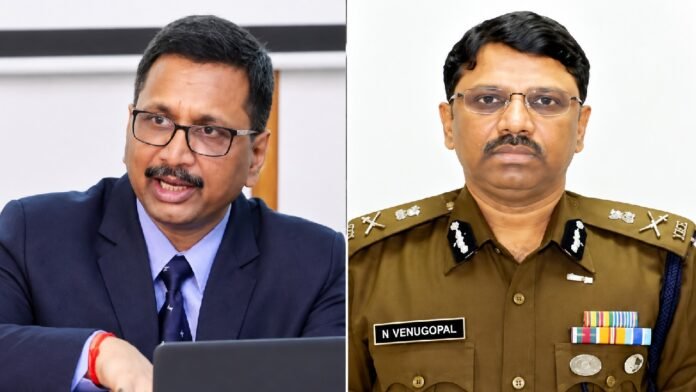
New Delhi: The Appointments Committee of the Cabinet (ACC) on Thursday (October 1, 2026) approved the appointment of two IPS officers, AYV Krishna (IPS:1995:AM) and Venugopal N(IPS:1995:HP), as Special Directors in the Central Bureau of Investigation (CBI).
According to an order issued by the Department of Personnel and Training (DoPT), both officers will be appointed as Special Directors from the date they assume charge of their respective posts.
AYV Krishna, currently serving as Additional Director in the CBI, will hold the post until his superannuation on May 31, 2030, or until further orders, whichever is earlier.
Similarly, Venugopal N., also serving as Additional Director in the CBI, will hold the post until his superannuation on December 31, 2027, or until further orders, whichever is earlier.
The order provides for the temporary upgradation of their posts from Additional Director (Level 15) to Special Director (Level 16), as a measure personal to each officer.
Vineet Kumar IAS Full Profile:Vineet Kumar is a 2013-batch Indian Administrative Service (IAS) officer of the Uttarakhand cadre. He is currently serving as Additional Secretary, Labour Department, Government of Uttarakhand.
He was appointed to the IAS through direct recruitment on the basis of the Civil Services Examination, 2012 and was allotted the Uttarakhand cadre. The Department of Personnel and Training confirmed him in the IAS with effect from 2 September 2015.
Additional Secretary, Labour Department, Government of Uttarakhand
Vineet Kumar IAS Educational Qualification
Vineet Kumar was born on 13 January 1984. He belongs to the 2013 batch of the Indian Administrative Service and was allotted the Uttarakhand cadre. Vineet Kumar graduated in Civil Engineering (B.Tech.) from IIT Bombay, one of India’s premier engineering institutions.
Vineet Kumar IAS Career
Vineet Kumar joined the IAS after being selected through the Civil Services Examination held in 2012. He underwent his initial IAS training at the Lal Bahadur Shastri National Academy of Administration, Mussoorie.
During his early service, he also served as an Assistant Secretary in the Ministry of Home Affairs during his Central training/attachment period from August to November 2015.
After completing his training, he served in several positions in Uttarakhand, including Chief Development Officer, Nainital, District Magistrate, Bageshwar and Additional Secretary in the Public Works Department.
Period
Post / Position
Department / Organisation
2013–2015
IAS Training / Junior Scale
Lal Bahadur Shastri National Academy of Administration, Mussoorie
31 Aug 2015–30 Nov 2015
Assistant Secretary
Ministry of Home Affairs, Government of India
June 2018–July 2020
Chief Development Officer
Nainital, Uttarakhand
July 2020–July 2022
District Magistrate
Bageshwar, Uttarakhand
July 2022–October 2025
Additional Secretary
Public Works Department, Uttarakhand
2024
Additional responsibilities
IT Development Agency (ITDA) and Director, USAC
October 2025–Present
Additional Secretary
Labour Department, Uttarakhand
Vineet Kumar as District Magistrate, Bageshwar
Vineet Kumar was appointed District Magistrate of Bageshwar in July 2020, after serving as Chief Development Officer of Nainital.
His tenure as District Magistrate continued until 2022. In a July 2020 administrative reshuffle, the Uttarakhand government appointed Vineet Kumar as the new DM of Bageshwar.
Vineet Kumar as Additional Secretary, Public Works Department
In July 2022, Vineet Kumar was transferred from the post of District Magistrate, Bageshwar and appointed Additional Secretary, Public Works Department and Forests in Uttarakhand.
Additional Responsibility of ITDA and USAC
In January 2024, Vineet Kumar, then serving as Additional Secretary, Public Works and Forestry Planning, was given additional responsibility of the IT Development Agency (ITDA) and as Director, Uttarakhand Space Application Centre (USAC).
New Delhi: The Central Board of Indirect Taxes and Customs (CBIC) has promoted two Indian Revenue Service (IRS) officers of the 1998 batch, Sonal Bajaj and Pankaj K Singh, to the grade of Principal Commissioner of Customs and Indirect Taxes.
According to an office order dated September 30, 2026, the promotions have been approved against the panel year 2026 and will take effect from the date the officers assume charge of the promotional post, but not before October 1, 2026.
The officers have been promoted to Level 15 of the Pay Matrix under the Higher Administrative Grade (HAG). Their regular postings will be decided later with the approval of the competent authority. Until then, they will assume charge of the promotional posts on an in-situ basis, on an “as is where is” basis.
Patna: Senior IAS officer Vinay Kumar(IAS:1999:BH) is reportedly leading the race to succeed Deepak Kumar (Retd.IAS:1984:BH) as Principal Secretary to the Chief Minister of Bihar, according to sources.
The post fell vacant following Deepak Kumar’s transfer to the position of Vice-Chairman of the Bihar State Disaster Management Authority (BSDMA) on September 30, 2026.
Vinay Kumar is currently serving as Principal Secretary, Finance Department, with the additional charge of Principal Secretary, Urban Development and Housing Department.
Several names are being discussed in bureaucratic circles for the post, but sources indicate that Vinay Kumar is currently ahead in the race.
New Delhi: The Public Enterprises Selection Board (PESB) has recommended Anil Kumar Mishra for the post of Director (Marketing) at IREL (India) Limited. He is currently serving as Chief General Manager (Institutional Business), Marketing Head Office, Mumbai, at Indian Oil Corporation Limited.
The recommendation was made at the PESB selection meeting held on October 1, 2026.
Mishra will succeed Rajnish Arvind Khale, who has been holding the post since June 2023 and is due to retire on November 30, 2026.
PESB advertised the vacancy on January 20, 2026, inviting applications from eligible candidates.
A total of 11 candidates appeared before the PESB selection panel for the post. They were:
Rabi Sankar Sabat, General Manager- Technical (MSP), IREL (India) Limited
Kailash Nimma, Chief General Manager, National Aluminium Company Limited
Puvvula Sai Srinivas, General Manager (Commercial), NMDC Limited
Sachindra Singh, Chief General Manager, Mangalore Refinery & Petrochemicals Limited
Ashok Kumar Mishra, Others, Chief General Manager (Inst. Business), Marketing Head Office, Mumbai, Indian Oil Corporation Limited
Anil Kumar Mishra, Chief General Manager (Institutional Business), Marketing Head Office, Mumbai, Indian Oil Corporation Limited
A Sivaram Krishnan, General Manager, Mangalore Refinery & Petrochemicals Limited
Amanpreet Singh Chopra, Senior General Manager, New Delhi, Engineers India Limited
Bibhudatta Rout, General Manager (Alternate Energy), Indian Oil Corporation Limited













 Get Latest Updates