The number of applications for the lateral entry into centrally sponsored IAS-level jobs could merely crossed 6000 mark as the deadline for entries end on 30th of July. Senior officials in the Department of Personnel and Training (DoPT) said, “We hoped for more interests but, with just over 6,000 applications, the number is lower than expected as one lakh applications were unanimously expected.
With the idea of bringing in “fresh ideas and new approaches” to governance and also to augment workforce, government
Opened the doors of the bureaucracy for private sector professionals, and on June 10 invited applications for 10 Joint Secretary-level posts through lateral entry as opposed to the UPSC examinations. This move was initiated after government’s policy think tank, Niti Aayog suggested the same.
Joint Secretaries are senior management in the government and lead policy making as well as implementation of various programmes and schemes of the department assigned to them. The joint secretary post is usually filled through the competitive exams conducted by the Union Public Service Commission (UPSC).
The government notification said that candidates having expertise in specific areas of revenue, financial services, economic affairs, agriculture, road transport and highways, shipping, environment and forests, new and renewable energy, civil aviation and commerce can apply for the posts.
While candidates from state governments and Central or state public sector undertakings will be appointed on deputation, the candidates from private sector will be appointed on a contract basis, the notification said.
The June 10 advertisement called for applications from those working at “comparable levels in private sector companies, consultancy organisations, international/multinational organisations with a minimum of 15 years’ experience”. The lateral entrants would have three to five-year tenures, according to the advertisement.
The government has cited examples of former Prime Minister Manmohan Singh and ex-deputy chairman of the erstwhile Planning Commission, Montek Singh Ahluwalia, as the examples of those who joined the government through the “lateral entry” process at various ranks.
The ‘lateral entry’ route will bypass the UPSC system under which 15 percent seats are reserved for the Scheduled Castes, 7.5 percent for the Scheduled Tribes and 27 percent for the Other Backward Castes in the Indian Administrative Services.
The Narendra Modi goverment on Tuesday upgraded (in-situ) the post of 07 IAS officers to Secretary/Special Secretary rank in Government of India.
They are :
1. Arvind Mehta (IAS:1984:HP), Secretary to the 15th Finance Commission, upgraded in the rank and pay of Secretary.
2. Ajoy Kumar (IAS:1984:BH), Secretary, National Commission for Backward Classes, upgraded in the rank and pay of Secretary.
3. Bhupendra Singh (IAS:1985:HY), Chairperson, National Authority for Chemical Weapons Convention, Cabinet Secretariat, upgraded in the rank and pay of Secretary.
4. Anil Shrivastava (IAS:1985:MP), Adviser, NITI Aayog, upgraded in the rank and pay of Secretary.
5. Sanjeev Gupta (IAS:1985:HP), Additional Secretary, Inter State Council Secretariat as Special Secretary,upgraded in the rank and pay of Special Secretary.
6. Arun Goel (IAS:1985:PB), Additional Secretary, Ministry of Culture as Special Secretary, upgraded in the rank and pay of Secretary.
7. R Buhril (IAS:1984:TN), Special Secretary, Inter State Council Secretariat, re-designated as Secretary, Inter State Council Secretariat.
The country’s top external intelligence agency, the Research and Analysis Wing (RAW), has reportedly fired four joint secretary level officers within a span of one year for non-performance.
The firings are part of a government drive to clean up all government departments of nonproductive officers at senior levels. The sackings have been pushed by the Department of Personnel and Training which back in 2015 let it be known that officers who have completed 30 years of service or have crossed 50 years of age could be let go under certain sections of law.
The officers who have been let go of the RAW has been repeatedly overlooked for promotions and had been turning “unproductive”.
Minister of State Jitendra Singh had told the Parliament last year that provisions to let go of officers under rule 56(j) had been invoked against 53 Group A officers and 123 Group B officers after July 2014. The said rule allows the government to prematurely terminate officers in public interest after due consideration of the officer’s service record.
Arun Kumar Sinha (IPS:1987:KL), the incumbent Director of Special Protection Group (SPG), has been Additional Director General rank in Government of India.
The central deputation tenure of Ms Limatula Yaden (IRS-C&CE:1996) as Director, Department of Health & Family Welfare has been extended upto March 31, 2019.
The Narendra Modi goverment on Monday has approved the empanelment of 27 IAS officers, belonging to 2001 batch, for appointment to the posts of Joint Secretary or equivalent at the Centre.
Officers empanelled as Joint Secretary/equivalent :
The Fugitive Economic Offenders Bill, which aims to prevent culprits from fleeing the country and evading legal proceedings, has now been passed by both houses of the Parliament. The passage of the bill assumes significance as the law will enable Indian authorities to bring within its purview economic offenders like Vijay Mallya and Nirav Modi.
The government has already been under severe criticism over several businessmen fleeing the country with thousands of crores of Indian bank’s money. It’s not that there were no laws to deal with fugitive economic offenders, but the present laws do not allow to impound offender’s property easily and typically litigations go on for years. But, under the Fugitive Economic Offenders Bill, once a person is declared an economic offender, his property will be confiscated, managed and disposed of. Any offenses involving funds over Rs 100 crore will be dealt with under this law. Investigative agencies can even seize properties that are not only in the name of the offender but also the ones that are benami.
Of late, there has been increase in the number of people who have defrauded the banks but have still gone scot free because of loopholes in the legal system. Therefore, it became expedient to bring in a special law to deal with such offenders. After it was known that Vijay Mallya had fled the country to avoid being arrested for economic fraud, Finance Minister Arun Jaitley had announced in last year’s Union Budget that the government would soon bring about a law that would allow the state to take possession of properties belonging to such offenders. The government has stood up to its commitment.
The Narendra Modi government first got the law implemented in the form of an Ordinance and later got it passed in the both houses of Parliament. Most MPs supported the bill because no one wanted to be seen siding with the fugitives. The main objective of the bill is to bring back economic offenders and punish them, retrieve bank’s money from them, and to pre-empt offenders from fleeing the country. Under the new law, the Court will issue a notice to the person named a ‘fugitive economic offender’. Within six weeks from the date of notice, the person will have to present themselves at “a specified place at a specified time”. If the offender fails to do so, they will be declared a ‘fugitive economic offender’ and their properties will be confiscated. Furthermore, the restraint from agitating any civil matters by any such person shall also act as a huge deterrent to the offender.
In the absence of offenders, it becomes very difficult for the courts to pursue cases against them. Needless to say it also becomes very difficult for investigation to move in right direction in the absence of the accused. It also not only create hurdles in the legal process but also wastes much of the precious time of the courts. And more importantly, these offenders bring the banking system to its knees by bleeding the banks of their money.
Now, with new law in place, it will be become easier for investigating agencies to get hold on to the economic offenders and confiscate their properties. It becomes cumbersome for investigating agencies to pursue cases against the offenders who take the citizenship of some other countries. It is now being reported that one of the fugitives Mehul Choksi has taken the citizenship of Antigua and Barbuda. Though it may not be easy for Indian authorities to extradite him with immediate effect, but after the new laws are in place, the investing agencies would be able to impress upon the authorities of the other country that the charges are of very serious nature and fugitive needs to be presented before the court. Otherwise also, the stringent law has its own deterrent effect.
For the most part of his two-year-long fugitive life in the United Kingdom, beleaguered liquor king Vijay Mallya has put up a defiant face, refusing to return and openly challenging Indian authorities. In an interview he had said, “By taking my passport or arresting me, they are not getting any money.” Mallya’s tone seems to have changed a lot this week. Reportedly, he has sent feelers to officials to say that he would like to return and face the law. It is being said that the creation of new law has brought about change in Mallya’s attitude. The Enforcement Directorate’s (ED) had sought action against him under the fugitive economic offender’s ordinance in an over Rs 9,000 crore bank fraud case. It was the first time that action was initiated under the ordinance promulgated by the Narendra Modi government.
Mallya is only a small fish among large loan defaulters and fraudsters thriving on the corporate-banker nexus. Compared with what the uncle-nephew duo of Mehul Choksi and Nirav Modi did to the Punjab National Bank (PNB), Mallya’s charges would be less serious in nature. Nirav Modi- Mehul Choksi–PNB fraud is worth more than Rs 12,000 crore.
The success of the Fugitive Economic Offenders law will depend on how well it is implemented. This law would prove to be a potent weapon, if rightly used.
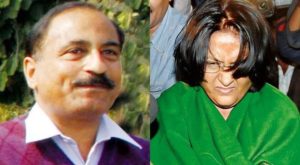
Bhopal: Former IAS couple Arvind Joshi and Tinoo Joshi have been sent to prison in connection with a money laundering case after they surrendered before a court here.
Judge Alok Awasthi of the special court for Prevention of Money Laundering Act (PMLA) sent the Joshis in judicial custody friday evening.
The court granted bail to Arvind Joshi’s parents–Nirmala Joshi (88) and H M Joshi (92)–against a surety of Rs 50,000 each in view of their old age, said an Enforcement Directorate (ED) official.
Joshi’s parents are co-accused in the case.
The court had issued a warrant against the accused on July 19 in connection with a case filed by the ED under the PMLA.
Arvind and Tinoo, both IAS officers, were dismissed from service in 2014 for allegedly amassing wealth disproportionate to their known sources of income.
During a raid at their house in Bhopal in 2010, the Income Tax officials allegedly found Rs 3.03 crore in cash. The Madhya Pradesh Lokayukta Police also filed a separate case against the couple for allegedly amassing assets worth a whopping Rs 41.87 crore.
The couple has not been convicted in these cases yet.
The ED, in its charge sheet, has accused them of laundering some of the ill-gotten wealth through dubious transactions.(PTI)

















 Get Latest Updates