

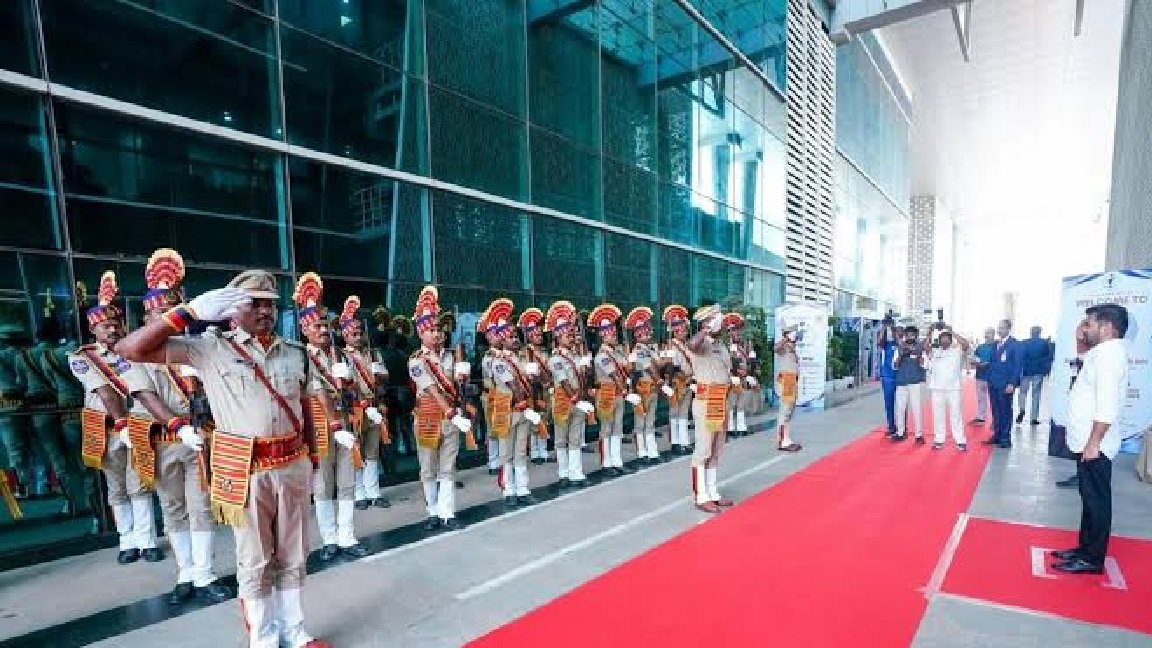
The Telangana Integrated Command and Control Centre (TGICCC) located in Banjara Hills of Hyderabad on Friday witnessed a large convergence of DGPs and senior police officers from all southern states and Union Territories on the occasion of the Southern Regional Police Co-ordination Conference (SRPCC). The participants discussed how the intelligence department can handle Gen Z protests.
They also discussed the best practices adopted by them, shared knowledge and deliberated on prevailing problems and how to tackle them.
Those attending the conference included Telangana DGP CV Anand, Karnataka DGP M A Salim, Tamil Nadu DGP Mahesh Kumar Aggarwal, Puducherry DGP Shalini Singh and Additional DGP and Head of Police Force (HoPF) of Lakshadweep Shankar Jaiswal. Besides, Ajitha Begum representing the Kerala DGP and IGP Ravi Krishna representing the Andhra Pradesh DGP also attended the conference.
Plus, top officers from central agencies including the Intelligence Bureau (IB), Central Bureau of Investigation (CBI), Enforcement Directorate (ED), Directorate of Revenue Intelligence (DRI), National Investigation Agency (NIA), National Security Guard (NSG), Central Industrial Security Force (CISF), Border Security Force (BSF), Central Reserve Police Force (CRPF) and Foreigners Regional Registration Office (FRRO) also attended the event.
During the conference, the DGPs gave presentations on the best practices adopted in their respective states, sharing knowledge that can be implemented elsewhere if suitable.
Besides, officials also discussed narcotics and how to coordinate better to control this menace to make India a drug-free country by December 31, 2029.
Discussions also covered issues like ISI-sponsored terrorism, post-Maoist steps, how the intelligence department should handle Gen Z protests, cybercrime, organised crime in economic offences, human trafficking, and the operation of interstate gangs, alongside institutional mechanisms for improved coordination.
Chief Minister A Revanth Reddy inaugurated the event and stressed the need for policing to change and reforms to be continuous.



















 Get Latest Updates