

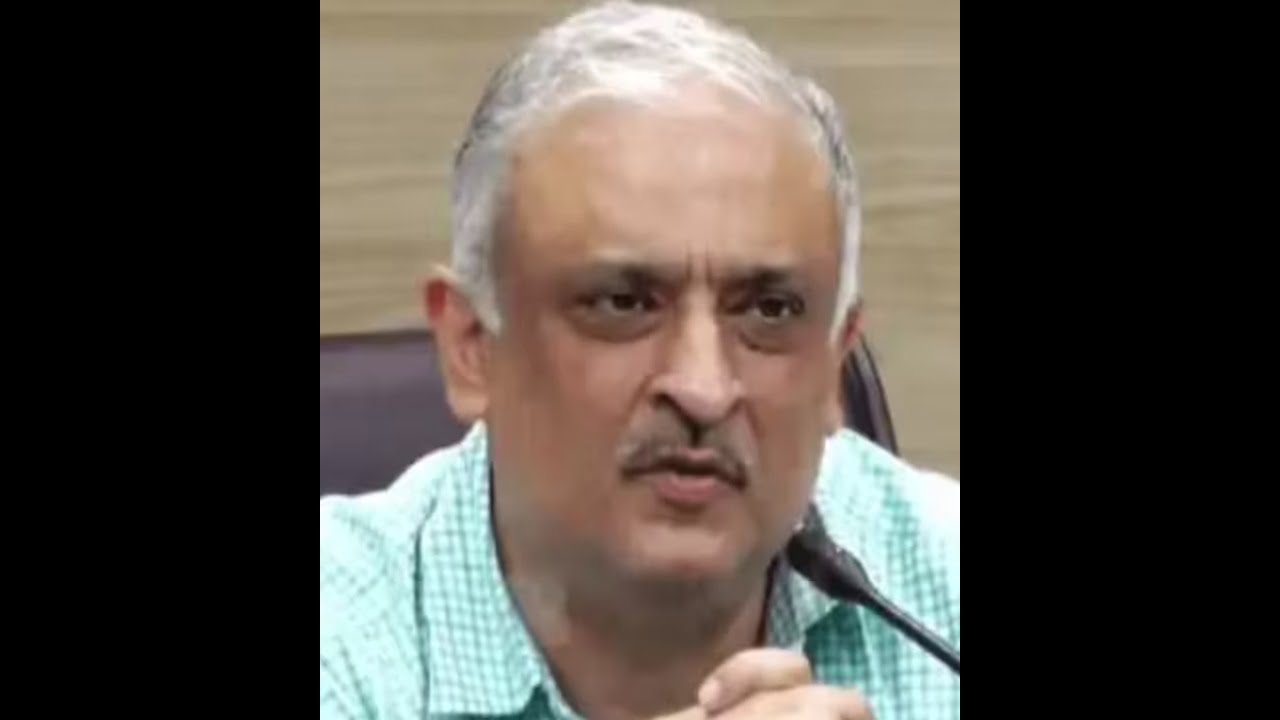
When Dr. Devesh Chaturvedi took charge as Secretary, Ministry of Agriculture and Farmers’ Welfare on August 6, 2024, it was not just another routine posting. He had spent many years working in the agriculture sector. He had seen it from the village level to the state and the Centre.
He succeeded Manoj Ahuja, a 1989 batch IAS officer, who returned to Odisha as Chief Secretary. For Dr. Chaturvedi, agriculture was not new. He had worked in this sector for a long time.
A Rare Blend of Technical and Administrative Depth
Dr. Chaturvedi is a 1990-batch IAS officer. He has a strong academic background. He studied Mechanical Engineering at IIT Kanpur. He completed his M.Tech from IIT Delhi. Later, he did a PG Diploma from IIM Bangalore. He also carried out doctoral research at IIT Delhi, though the degree was not formally awarded.
Those who have worked with him say he studies issues carefully. He looks at data before taking decisions. At the same time, he keeps ground realities in mind.
After completing his training, Dr. Chaturvedi began his career as Executive Magistrate in Etawah. Over the years, he went on to serve as District Magistrate and Collector in several key districts including Pithoragarh, Deoria, Bulandshahr, Kanpur Dehat, Gorakhpur and Prayagraj.
Early Administrative Foundations
These field assignments exposed him to rural realities agricultural distress, supply chains, irrigation challenges, procurement mechanisms and farmer welfare schemes experiences that would later shape his policy perspective.
He subsequently rose to serve as Divisional Commissioner in major divisions including Prayagraj and Lucknow, strengthening his administrative command over large regions.
Diverse Governance Exposure in Uttar Pradesh
Before specialising in agriculture leadership, Dr. Chaturvedi held key positions across multiple departments in Uttar Pradesh. He handled Food & Civil Supplies, Forest, Election, Tourism, Education, Minority Welfare & Muslim Waqf, and the Planning Department. He also served as Director General of the State Planning Institute.
This cross-sector experience sharpened his understanding of governance linkages from supply chain management to rural development and institutional planning.
Two Central Deputation Phases
Dr. Chaturvedi’s exposure to central policymaking came through two deputation stints from June 2007 to May 2012 and again from May 2015 to June 2019. During these tenures, he worked in the Ministry of Tourism, the Department of Personnel & Training, and significantly, in the Department of Agriculture & Farmers’ Welfare.
His second stint in the Agriculture Ministry proved defining. From May 2018 onwards, he served as Joint Secretary and was later elevated as Additional Secretary in the same Ministry. His involvement ranged from policy design to programme monitoring.
After returning to Uttar Pradesh in June 2019, he was appointed Principal Secretary (Agriculture) and later Additional Chief Secretary handling Agriculture, Agriculture Education & Research, Agriculture Marketing, Agricultural Foreign Trade & Export Promotion, along with the charge of Agriculture Production Commissioner. He also held the portfolio of Additional Chief Secretary, Appointment & Personnel, besides serving as Director General (Training), Lucknow.
By the time he was appointed Union Agriculture Secretary in 2024, he had accumulated a rare combination of central policy experience and state-level execution in agriculture governance.
Appointment as Union Agriculture Secretary
His appointment as Agriculture Secretary was widely viewed within bureaucratic circles as a natural progression. Few officers had spent as much time working on agriculture policy at both levels of government.
During his tenure as Secretary (August 2024 – 2026), he focused on strengthening policy coordination, improving Centre–state convergence, and ensuring time-bound implementation of flagship agricultural schemes. His approach emphasised structured monitoring mechanisms and clarity in inter-departmental coordination.
At his farewell ceremony organised by the Ministry, Union Minister Shivraj Singh Chouhan described his tenure as exemplary and marked by foresight and commitment. The Minister highlighted his role in reinforcing implementation efficiency and strengthening institutional processes within the Department.
Leadership Style and Legacy
Colleagues describe Dr. Chaturvedi as methodical, detail-oriented and institution-focused. His tenure did not revolve around headline-driven interventions but around system strengthening — an approach that often defines long-term administrative impact.
What distinguished his leadership was the continuity he represented. Having handled agriculture in Uttar Pradesh extensively and later at the Centre, he understood both the policymaker’s constraints and the implementing officer’s challenges.
His career reflects a broader pattern within the IAS where technical expertise, field administration, and central policy exposure converge to produce sectoral specialists.
As he demits office, his journey stands as an example of how sustained sectoral engagement can shape national-level leadership. In the evolving landscape of agricultural reforms, his tenure represents a bridge between policy architecture and ground-level execution.














 Get Latest Updates