

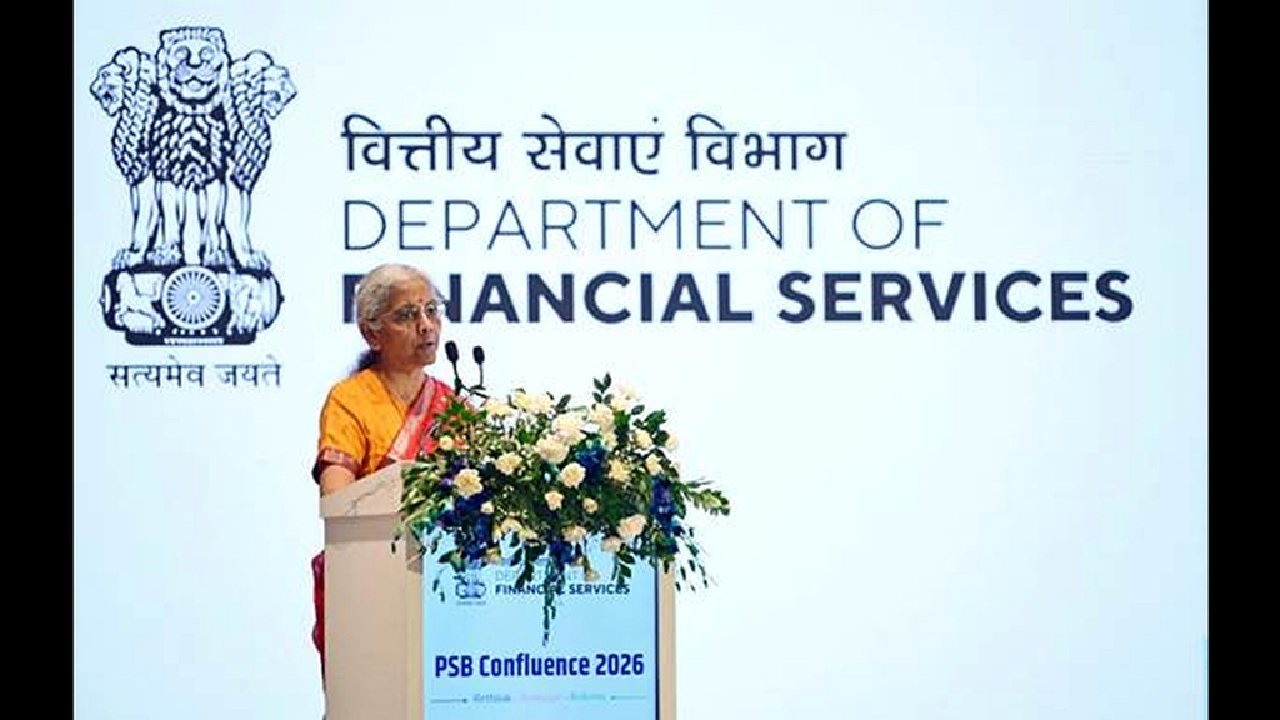
New Delhi: The two-day PSB Confluence 2026, organised by the Department of Financial Services (DFS), Ministry of Finance, concluded with a focus on turning deliberations into concrete measures for strengthening the next phase of India’s banking and financial sector.
The Confluence brought together senior leadership of Public Sector Banks (PSBs) and Public Financial Institutions (PFIs), government officials and domain experts to discuss seven key areas affecting the future growth of banking and financial services.
On the second day, discussions centred on agriculture and horticulture value-chain infrastructure, Priority Sector Lending (PSL) and the credit-card business. The thematic groups subsequently presented their key recommendations and proposed actions during debriefing sessions.
Addressing the concluding session, Union Finance and Corporate Affairs Minister Nirmala Sitharaman called upon PSBs and PFIs to move beyond discussions and focus on implementation. She urged the institutions to leverage their existing strengths, anticipate emerging opportunities and build capabilities aligned with India’s evolving economic requirements.
A key initiative emerging from the Confluence is a month-long banking campaign for youth above 16 years of age, which PSBs have been asked to undertake from October 2, 2026 through the Indian Banks’ Association (IBA). The campaign is aimed at encouraging young people to enter the formal financial system and establishing long-term banking relationships with them.
As part of the proposed initiative, a common online portal/application for youth is envisaged to provide information on relevant banking services as well as opportunities related to education, skilling and entrepreneurship. The campaign is also expected to include outreach programmes at colleges, universities, skill institutions and other campuses.
Sitharaman also stressed the need for closer monitoring of Priority Sector Lending. PSBs were advised to track individual targets and sub-targets more closely, identify potential shortfalls at an early stage and adopt appropriate strategies to ensure productive credit reaches the intended beneficiaries.
The discussions on agriculture and horticulture focused on financing the wider value chain rather than limiting credit to primary agricultural activity. Areas such as Farmer Producer Organisations (FPOs), storage, processing, logistics and market linkages were identified as having scope for greater financing support from banks.
The Confluence also examined ways to reimagine the credit-card business, with discussions covering digital onboarding, increased cross-selling among existing customers and opportunities arising from the integration of RuPay and UPI.
The discussions were supplemented by industry perspectives from CA Arvind Agarwal, Director, VNR Group, on agriculture and horticulture value-chain infrastructure, and Sanjay Mehndiratta, Director, Toy Zone, on Priority Sector Lending.
The Secretary, Department of Financial Services, said the Confluence had helped identify clearer priorities and actionable measures across the seven themes. The participating institutions will now be expected to take these recommendations forward with defined responsibilities and realistic timelines.
The PSB Confluence 2026 is thus intended to serve as a roadmap for PSBs and PFIs to strengthen financial inclusion, support emerging economic opportunities and contribute to India’s broader development objectives under the vision of Viksit Bharat 2047.




















 Get Latest Updates