

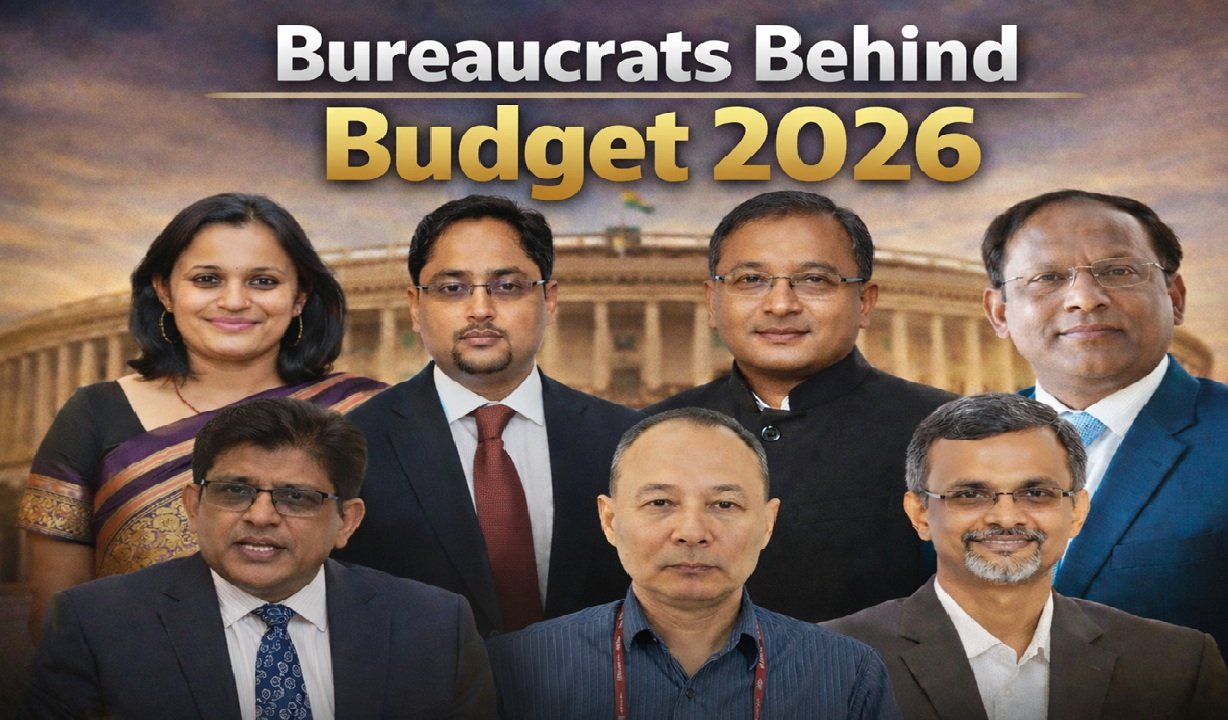
While Finance Minister Nirmala Sitharaman presented the Union Budget 2026 in Parliament, the document marked the culmination of months of intensive work by a core group of senior bureaucrats in the Ministry of Finance and allied departments, who quietly shaped India’s fiscal roadmap for the year ahead.
At the centre of the Budget-making exercise was Anuradha Thakur (IAS:1994:HP), Secretary, Department of Economic Affairs (DEA), who led the overall coordination and drafting of the Budget. The DEA, through its Budget Division, finalised the macroeconomic framework, fiscal deficit targets and expenditure ceilings after extensive consultations with line ministries.
The tax architecture unveiled in Budget 2026 was largely shaped by Arvind Shrivastava (IAS:1994:KN), Secretary, Department of Revenue. His department worked on revenue projections, rationalisation of direct and indirect taxes, and duty restructuring, which together formed the backbone of the taxation proposals announced in Parliament.
Expenditure priorities were scrutinised by Vumlunmang Vualnam (IAS:1992:MN), Secretary, Department of Expenditure, whose team vetted demands for grants from various ministries. The department played a decisive role in finalising allocations for flagship schemes, capital expenditure and subsidy management while ensuring fiscal discipline.
The financial sector components of Budget 2026 were shaped by M Nagaraju (IAS:1993:TR), Secretary, Department of Financial Services. His inputs covered public sector banking reforms, credit flow, financial inclusion initiatives and regulatory measures, many of which were reflected in the Budget’s focus on strengthening the banking system and supporting economic growth.
Disinvestment and asset monetisation proposals announced in the Budget were prepared under the supervision of Arunish Chawla (IAS:1992:BH), Secretary, Department of Investment and Public Asset Management (DIPAM). The department worked on identifying strategic opportunities for value realisation from government assets, aligning disinvestment targets with market conditions and broader fiscal objectives outlined in the Budget.
Public sector enterprise reforms featured in Budget 2026 were supported by inputs from K Moses Chalai (IAS:1990:MN), Secretary, Department of Public Enterprises. His department contributed to policy planning on PSU performance, governance reforms and efficiency measures, which fed into the government’s broader approach to strengthening state-owned enterprises.
Providing the analytical foundation for the Budget was V Anantha Nageswaran, Chief Economic Adviser (CEA). His office prepared the Economic Survey and advised the government on growth projections, inflation trends and global economic risks, shaping several macro-level policy choices reflected in the final Budget document.
By the time Union Budget 2026 was tabled in Parliament, it represented the final outcome of this coordinated bureaucratic effort—refined through inter-ministerial negotiations, political vetting and fiscal scrutiny. While the Finance Minister remains the public face of the Budget, its substance carries the clear imprint of the senior civil servants who crafted it behind closed doors.





















 Get Latest Updates